
Candidate Interview: Darrell Harris
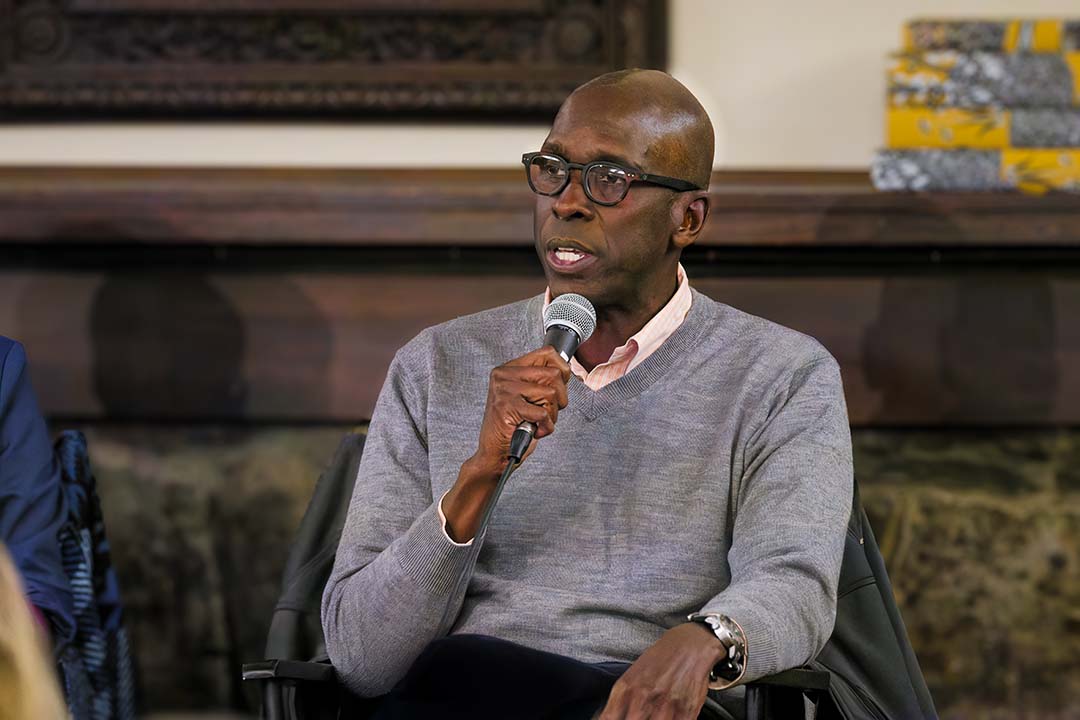
Weston Today photo
Darrell Harris is the Republican candidate for State Representative in the 135th district, which contains Weston, Redding, and part of Easton.
In our interview, Mr. Harris said he grew up in a housing project in The Bronx, got into The Bronx High School of Science, attended Yale, and went to Wall Street as a broker, trader, and in structured finance. After 2005, he joined a variety of startups ranging from cellphone infrastructure brokerage to medical devices, medical testing, and behavioral health. Along the way he was a consultant at the Milken Institute, working on philanthropic efforts.
The move to Easton in 2019 was, he said, “the opposite of growing up in The Bronx. I kind of pinch myself every day.” He said raising a family there is “a real gift.”
Mr. Harris is the chair of the Easton Republican Town Committee. He said an important part of the role is to recruit people to fill positions on boards and commissions. “It was hard to find people to run” for State Representative, he said, so he stepped up himself.
Focus
Mr. Harris’s campaign is largely based on local control, particularly when it comes to land use.
“Hartford treats us as a place money comes from,” he said. “When we want something back, all we get is reasons why it can’t be done.” The community needs “a forceful advocate,” he said, one who could “educate the state as to why the district is the way it is and not take us for granted.”
Mr. Harris said two and three acre zoning came because the Saugatuck Reservoir supplies water to much of Fairfield County and “the State knew that this needed to be protected. The deal was that if people in the area would not have businesses, not densify, and protect the reservoir, then we would shoulder the higher burden of taxes.”
Mr. Harris said State affordable housing goals “are laudable,” but not realistic in Weston, Redding, and Easton.
“I don’t have all the answers,” he said. “And I think when I get to Hartford I’ll get a real education as to how things are done.” He said “the State should set the goals, but they should actually be helpful in facilitating what towns need,” a bottom-up approach versus one from the top down.
If towns believe there are areas where they “could actually densify without doing undue damage,” he said the State should be willing to provide resources or flexibility on regulations “that are impediments to developers and other people.”
Filling the gap
Mr. Harris said he supports State spending to fill the gap caused by the cancelation of federal funds for SNAP benefits, Medicaid, and health insurance.
“I’m not here to say I want to cut taxes,” he said. “That’s putting a meat cleaver to where a scalpel would be appropriate.” He said the State should “take the hit” and raise taxes to replace lost federal funds, but not pass the burden down to cities and towns.
Mr. Harris said he supports State initiatives on early childhood education and emphasized that the Head Start program should continue. “People may disagree on how programs are implemented,” he said, “but I don’t think people disagree on the broad thrust of why these things are done.”
The political climate
We asked Mr. Harris for his take on the current state of political discourse. “There’s not a single point in history,” he said, “where we’ve had peace, love, and comity between groups of people that disagree politically. And that probably won’t change,” especially in the age of social media.
On the local level, he said, the tone of his debate with State Rep. Anne Hughes illustrates how “a proper airing of differences and political philosophies should take place.”
“Win or lose,” he said, “I’m going to be running into Anne at a coffee shop, Town Hall, or some event. So I have to look at myself and conduct myself in a way where my son and my family could be proud of how I’ve acted.”
“I think all of us are raised to know what’s polite conversation and what isn’t.”