
Weston Middle School Back in Focus
Weston Today photos
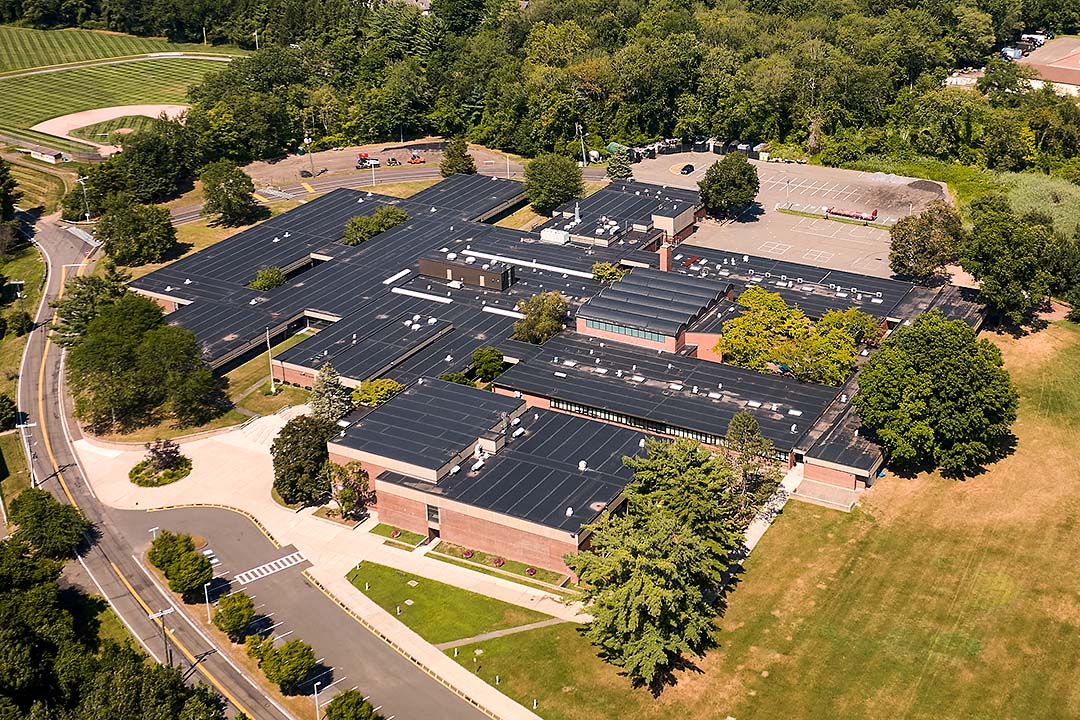
The Weston Board of Education aims at November of 2026 for a referendum where voters would be asked to approve funding a new or renovated Weston Middle School.
A special board session on Monday with Colliers Project Leaders and SLAM, an engineering and architecture firm, served as a brief recap of studies and reports over the past eight years and a more detailed review of steps required for a referendum and to apply for State reimbursements.
At the moment, the question of whether to build a new school or extensively renovate the existing one remains something of a jump ball.
In June, a preliminary report by the consultants and engineers concluded that the middle school, while needing extensive work, is structurally sound and would likely qualify for the higher reimbursement rates that go with renovation.But the report also suggested that building an entirely new school might cost about the same as renovating, would be done much more quickly, and would avoid disrupted education that goes with prolonged construction in an occupied building.
Timelines
At an earlier meeting on November 17, the newly constituted Board of Education agreed with newly elected chair Deborah Low’s “sense of urgency” to expeditiously decide and act on Weston Middle School.
While a considerable amount of work lies ahead in a fairly short time, the board would like to make a June 30 deadline to apply for State reimbursement grants. A referendum — or at least a commitment to hold one — is required as part of the application process.
The Board of Selectmen would have to agree to call a referendum and authorize the school board to apply for grants. The selectmen would also have to form a special building committee and authorize the district to have schematic designs drawn.
If school officials can’t make the June 30 deadline in 2026, a November referendum (if approved) would still be valid for a try in 2027. This would, of course, delay progress while costs likely escalate.
The numbers
Median estimates presented in June put total costs to renovate at about $124 million versus $126 million to build new. Because reimbursement rates favor renovation, net local costs to renovate would be $110 million versus $114 million for a new school.
Asterisk No. 1: If it can be demonstrated that building new would actually be cheaper than renovating, or if special considerations apply, it is possible that the Legislature could assign a higher reimbursement rate to a new building.
Asterisk No. 2: The June estimates were based on construction, new or renovated, of a 120,000 square-foot school. (The current building is 147,000 square feet.)
But State regulations calculate reimbursement eligibility based on peak enrollment over the next eight years. Recently completed projections for WMS put the peak at 547 students, which translates for reimbursement purposes to a school no larger than about 93,000 square feet.
If intentions stay at 120,000 square feet, reimbursements would be cut by more than half. However, if a 93,000 square-foot school would do the job for Weston, it would conceivably cost many millions less than the amounts estimated in June.
What comes next
Going forward, the Board of Education plans to hold one additional meeting each month solely dedicated to the school project. Ms. Low said plans also include public engagement sessions, improved communications with the community, and collaboration with Town Hall. Presumably, a clearer picture will also emerge of broader facility needs on campus.
It also seems the board must proceed with a more in-depth engineering assessment of the middle school, an extensive probe of every feature, system, nook and cranny. An old building is like Forrest Gump’s box of chocolates: you never know what’s inside.
The board will also explore other questions posed on Monday evening. Member David Felton wondered if reconfiguring grade levels might lead to economies or more grant dollars, and member Peter Gordon suggested investigating whether the State might be interested in transforming WMS into a regional magnet school, which would increase the reimbursement rate to as much as 80 percent.